If you’ve been shopping for an engagement ring, a tennis chain or an iced-out watch, you’ve almost certainly seen the word moissanite next to the word diamond. They look alike at a glance, but they are two different gemstones with different strengths. This guide sets out the real differences, without the sales talk, so you can decide what fits your style and budget.
What is moissanite?
Moissanite is silicon carbide, a mineral first identified in 1893 by the French chemist Henri Moissan in fragments from a meteorite crater in Arizona. Natural moissanite is so rare that it has never been mined commercially. Every moissanite you see in jewellery today, including ours, is lab-created: grown under controlled conditions and then cut and polished like any other gemstone.
That makes moissanite a gemstone in its own right. It is not a “fake diamond”, and it is not a diamond either. A good seller will always describe it as moissanite.
What is a diamond?
A diamond is pure carbon crystallised under extreme heat and pressure. Natural diamonds are mined; lab-grown diamonds are chemically the same as natural ones but are made in a laboratory. Both are graded on the well-known 4Cs: cut, colour, clarity and carat.
Moissanite vs diamond at a glance
| Property | Moissanite | Diamond |
|---|---|---|
| Material | Silicon carbide | Carbon |
| Origin in jewellery | Lab-created | Mined or lab-grown |
| Hardness (Mohs scale) | 9.25 | 10 |
| Refractive index (brilliance) | about 2.65 to 2.69 | about 2.42 |
| Dispersion (“fire”) | about 0.104 | about 0.044 |
| Weight for the same size | about 10% lighter | heavier |
| Typical price | a small fraction of a diamond | much higher, rising sharply with carat |
Sparkle: moissanite has more fire
The biggest visible difference is the type of sparkle. Moissanite bends light more strongly than diamond (a higher refractive index) and splits it into colours more than twice as much (higher dispersion). In practice that means:
- Moissanite throws more rainbow-coloured flashes, especially in sunlight or under spotlights.
- Diamond shows more white sparkle and contrast, with a little less colour.
Neither is “better”. Some people love the extra fire of moissanite, particularly in larger stones and in fully iced-out pieces where hundreds of small stones catch the light together. Others prefer the cooler white sparkle of diamond.
Hardness and durability
On the Mohs scale, diamond is a 10 and moissanite is a 9.25. That makes moissanite harder than sapphire, ruby and every other popular gemstone, and well suited to everyday wear, including rings that get knocked about.
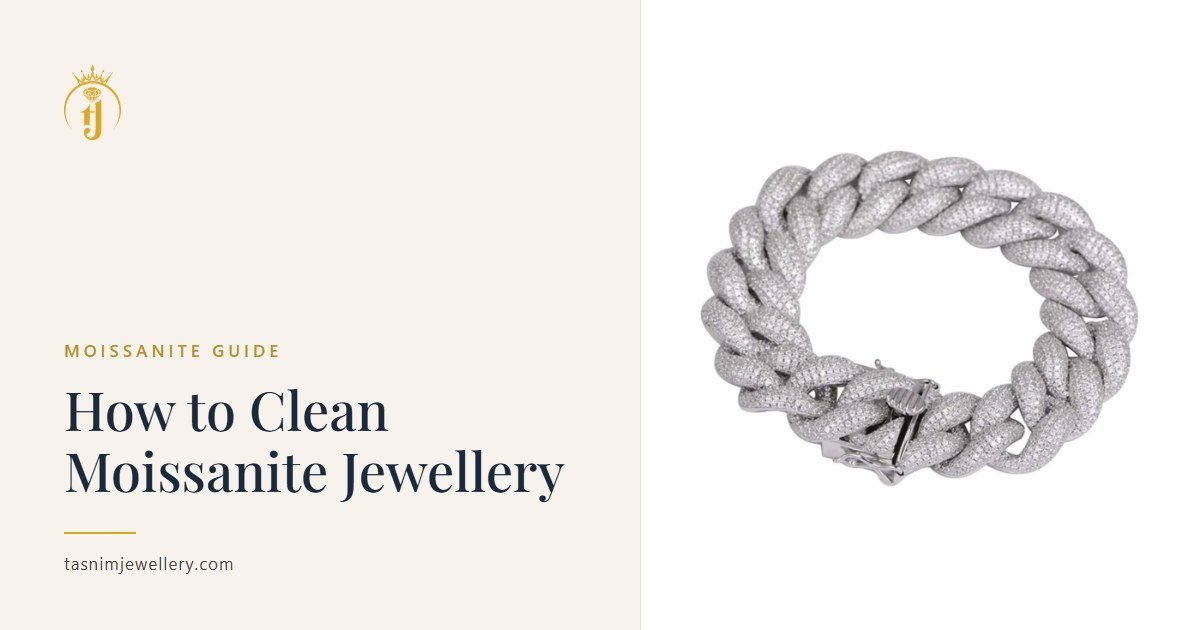
Moissanite is also very heat-resistant and does not go cloudy over time. Like any gemstone it can collect oil and dust, which dulls the sparkle until you clean it. Our guide on how to clean moissanite jewellery covers that in five minutes.
Colour and clarity
Early moissanite had a faint yellow or green tint. Modern lab-created moissanite is grown to be colourless and eye-clean, which is why you’ll see listings describe stones as “VVS” (very, very slightly included: flaws you can’t see without strong magnification).
Diamonds vary much more. A colourless, high-clarity diamond costs a great deal more than a slightly tinted or included one of the same size.
Size and weight: why moissanite is sold by millimetres
Moissanite is lighter than diamond, so a moissanite of the same visible size weighs less. For that reason moissanite is often described by its diameter in millimetres or by its “diamond equivalent weight” (DEW). For example, a 6.5 mm round stone looks like a 1 carat round diamond from the top, whichever gemstone it is. When you compare stones, compare millimetres, not just carats.
Price
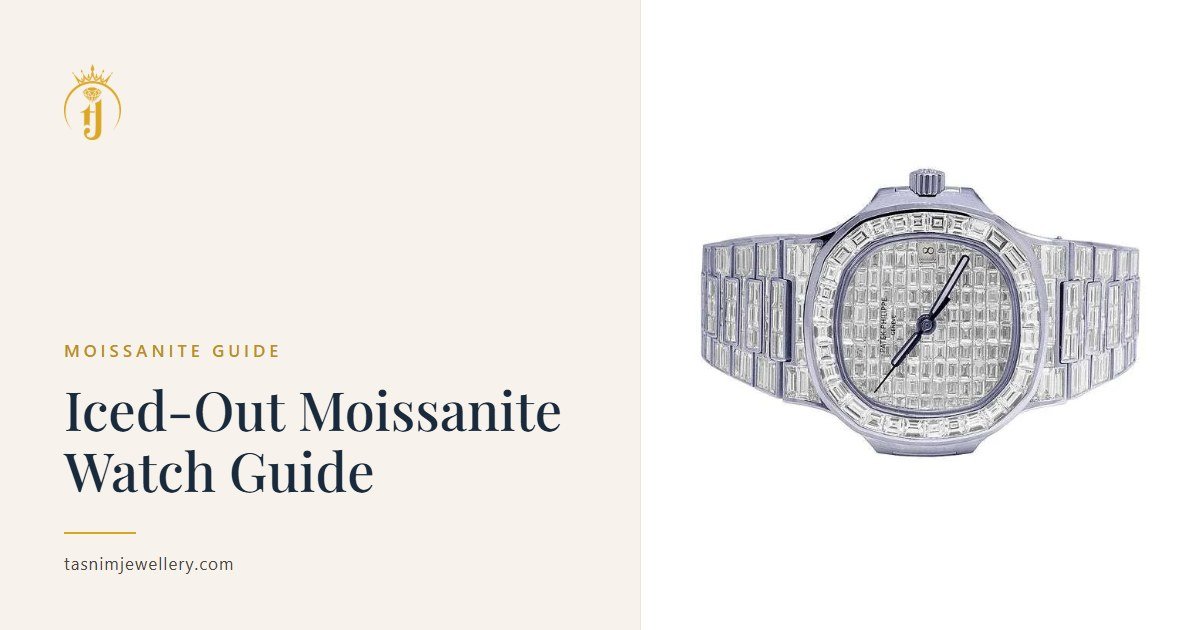
This is where the gap is widest. Because moissanite is lab-created and not priced on the diamond market, a large, bright moissanite costs a small fraction of a diamond of the same size. That is what makes pieces like moissanite tennis chains and fully set iced-out moissanite watches possible at a reachable price: covering a whole watch case and bracelet in diamonds would cost many times more.
Shop the guide
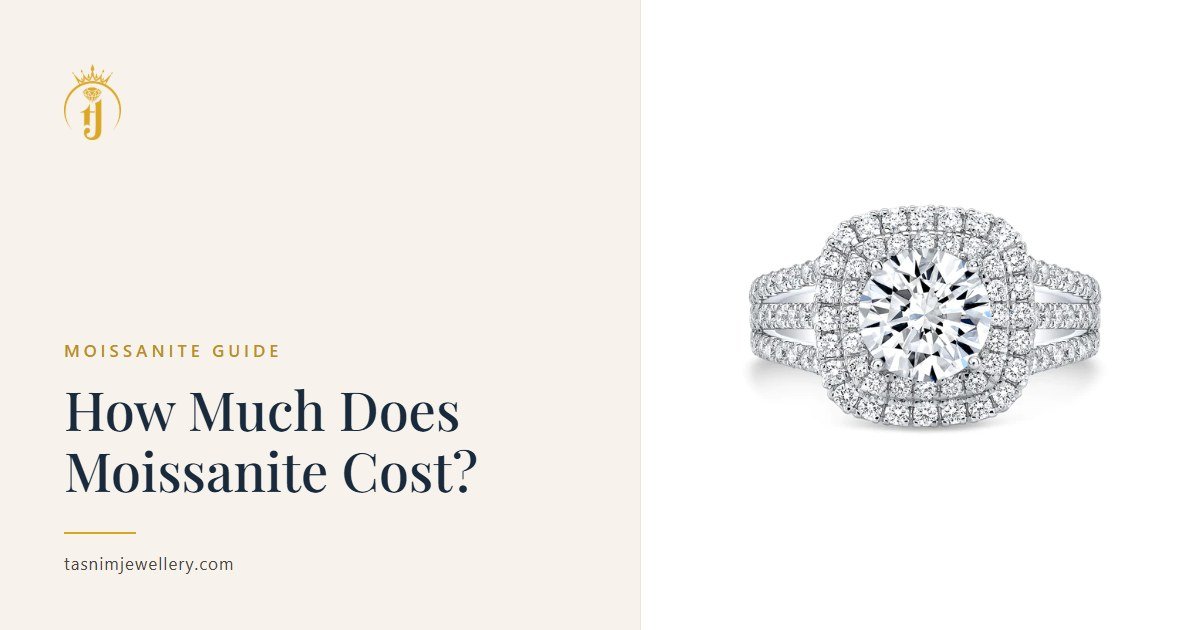
Moissanite engagement rings


Can people tell moissanite from diamond?
Most people can’t tell by eye, especially once the piece is being worn. A trained jeweller may notice the extra rainbow fire, and under magnification moissanite shows “doubling” of the facet edges because it is doubly refractive. Some diamond testers can also tell them apart. We explain exactly how in Does moissanite pass a diamond tester?
Which should you choose?
Choose moissanite if you want:
- A big, bright look for your budget, including large centre stones and fully iced-out designs.
- A hard, durable stone for everyday wear.
- More fire and colour in the sparkle.
Choose diamond if you want:
- The traditional choice and the name “diamond” itself matters to you.
- Long-term resale value (though most jewellery, diamond included, resells for well below what you paid).
Frequently asked questions
No. Moissanite is its own gemstone, silicon carbide, with its own properties. It only becomes “fake” if someone sells it as a diamond, which a reputable seller never does.
No. Moissanite does not go cloudy or change colour with age. If it looks dull, it needs cleaning: soap, warm water and a soft brush will bring it back.
Yes. With a hardness of 9.25 it stands up well to daily wear, and it lets you choose a larger centre stone for the same budget. See our moissanite engagement ring buying guide for shapes, settings and sizes.
Moissanite holds its looks for a lifetime, but it is not an investment and has little resale value. Buy it because you love wearing it.
Shop moissanite jewellery
Every stone we set is moissanite, described as moissanite. Browse our moissanite engagement rings, tennis chains, moissanite jewellery and moissanite watches, all with free worldwide shipping, 15-day returns and a free 3-month warranty.